Nigerian Capital Market: From Reform to Origination – By Peter Omoregie, Managing Director, CardinalStone Securities
For years, Nigeria’s capital market has been described as one to watch. Currently, it ranks high amongst Africa’s capital markets, backed by the consistent performance of the stock exchange (NGX), a growing fixed-income ecosystem, and a reform-driven regulatory agenda.
With FMDQ reporting the total outstanding balance of Nigerian debt instruments at c.₦84.0 trillion, spanning bonds, treasury bills, OMO instruments, and commercial papers, the fixed income market looks set to continue to play a vital role in Nigeria’s capital market— serving as a strong channel for both public and private capital formation. An even more exciting story can be told for the equities market. Since 2023, the Nigerian equities market has delivered a near-threefold increase in market capitalisation, reaching ₦126.2 trillion (or $91.7 billion). This accelerated growth is mostly attributable to improvements in Nigeria’s macroeconomic environment and a return to orthodox policies that have led to significant re-ratings of Nigerian equities. These factors and an overall pro-market disposition also paved the way for a chain of corporate and institutional actions such as new listings, banking sector recapitalisations, adjustments to PFA equity allocation limits, and business combinations that added further support to the market. Market interest and participation were boosted across the different investor cadres, and favourable valuations justified market moves. However, following extended gains, market watchers are now asking the critical question: Is the investment case for the Nigerian market still compelling at current levels?
The answer lies in understanding the structural shifts that have shaped the investment landscape over the last 3 years. Most notably, the foreign exchange market reforms, which followed the unification of previously fragmented exchange-rate windows, and subsequently the introduction of the Electronic Foreign Exchange Matching System (EFEMS) to enhance FX transactions in the Nigerian Foreign Exchange Market (NFEM). The combination of these initiatives has enhanced price discovery, minimised distortions, and boosted transparency for local and international investors. More specifically, these reforms have sparked the return of billions in previously sidelined capital to Nigerian assets. Nigerian equities saw a considerable increase in foreign participation, expanding from 9.9% in 2023 to 22.2% in 2025, according to the Foreign Portfolio Investment report by the NGX. Foreign flows have also made their way to the fixed-income market, particularly OMO bills, as the country’s carry trade remains very attractive. For us, the combination of attractive carry, relative cheap equity valuations, and improving macros leave legroom for gains in select equity names and fixed income assets.
Elsewhere, the enacted Investments and Securities Act (ISA) highlights the SEC’s move to align the Nigerian capital market with global best practices, whilst deepening the legal and regulatory framework. Precisely, the Act now officially recognises cryptocurrencies and other virtual assets as securities, establishing the very first and much-needed legal framework for digital assets in Nigeria. The Act forms a stronger foundation upon which more reforms can be adopted to sustain market integrity. Building on ISA 2025, the SEC issued new minimum requirements for capital market operators in a move to enhance the financial soundness and operational resilience of market operators. Other key considerations include promoting market stability and systemic risk mitigation, and supporting innovation and orderly development of new market segments, including digital assets and commodities markets. SEC also embarked on the most aggressive regulatory capital adjustment in Nigeria’s financial markets’ history by raising the capitalisation requirement for Nigeria’s capital market operators by at least 200.0%, with a deadline of June 20, 2027.
Additionally, market infrastructure is also evolving. The SEC successfully initiated the transition of the Nigerian capital market to a T+2 settlement cycle (from T+3 previously), in alignment with global market standards.
Following a recent circular, the market is set to transition further to a T+1 settlement cycle effective Friday, May 29, 2026. By shortening the timing between trade execution and settlement, the market continues to become more competitive, liquid, and resilient. By shortening the timing between trade execution and settlement, the market simply becomes more competitive, liquid, and resilient.
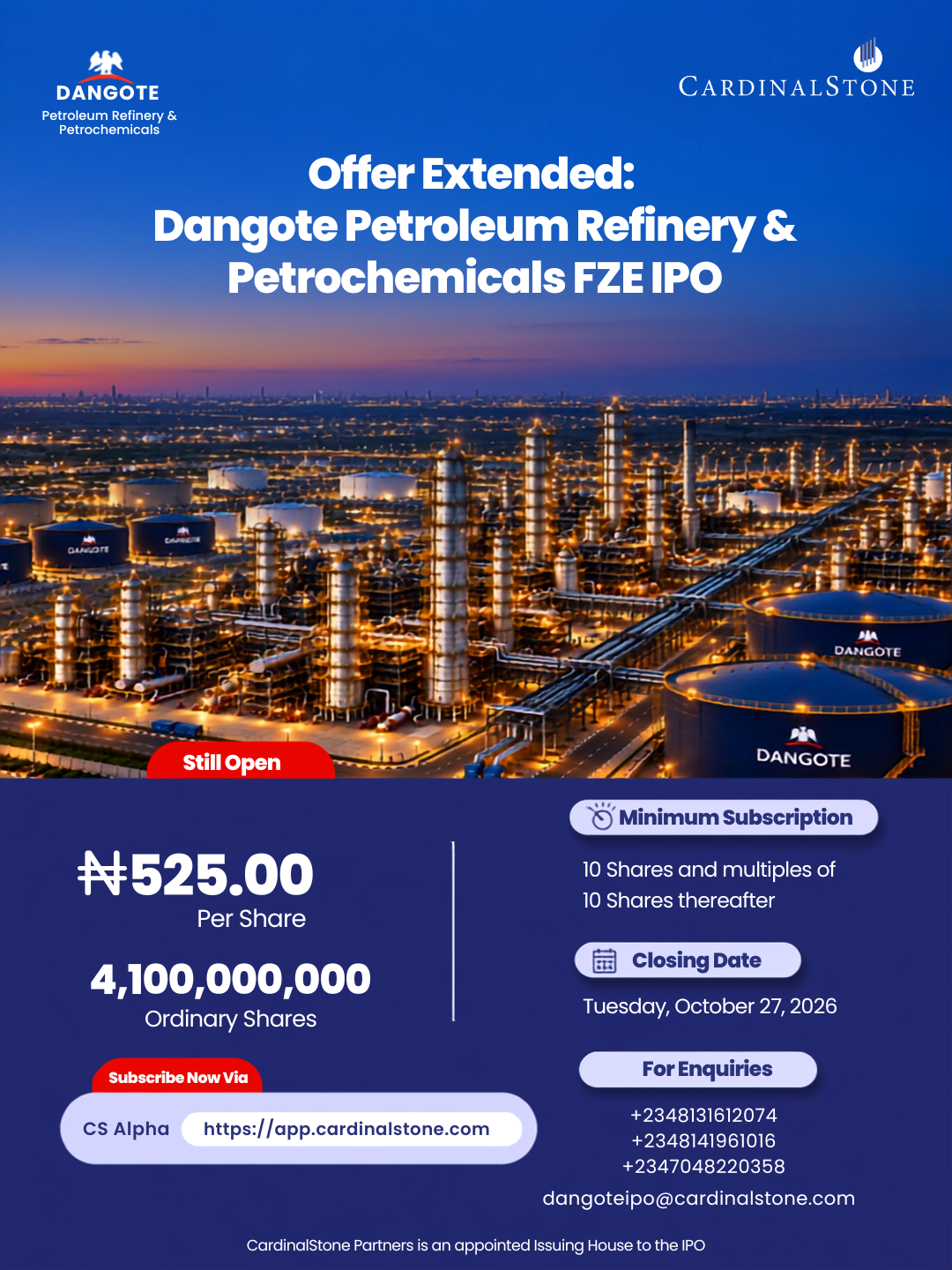
As Nigeria’s Capital Market continues to evolve, the strongest origination opportunities exist where balance-sheet repair, expansion and transition intersect. Capital raises from insurance companies, as necessitated by the new minimum capital requirement by NAICOM is one to look out for. Also, the widely anticipated listings of NNPC, Dangote Fertiliser, and the Dangote Refinery should continue to drive market buzz. Commercial papers for quick working capital fixes and corporate bonds for longer-term needs could also offer exciting investment opportunities, too. Against this backdrop, positioning becomes critical. Institutional investors with long-term capital, flexible mandates, and the ability to move early are better placed to capture these emerging opportunities. CardinalStone, through its offerings spanning excellence in brokerage, financial advisory, capital markets execution, and insightful market research, is uniquely equipped to work with investors seeking access to primary market opportunities in Nigeria, and with corporate issuers navigating capital raising needs and strategic opportunities.
As exciting investment opportunities surface, it is imperative for investors to be aware of potential underlying risks. The Nigerian capital market, like any other capital market in the world, is constantly met with several risk factors. Investors constantly price-in these risks, which may stem from interest rate movements, foreign exchange volatility, inflation, and policy uncertainty. Furthermore, limited liquidity, low trading activity amid regulatory and compliance intricacies are also identifiable risks quite peculiar to the Nigerian market. However, these risks are often overestimated, leading to missed market opportunities. A common misconception is that Nigeria’s capital market is too risky or illiquid to invest in. Some would even say returns are poor and overly volatile, when in fact, Nigerian assets, particularly equities, have delivered some of the strongest returns globally in recent years.
Prospectively, the market appears poised for another year of positive returns, receiving a major uplift in 2026 upon the potential reclassification of Nigeria to frontier market status by FTSE Russell at the agency’s upcoming review cycle. Additionally, JPMorgan continues to eye Nigeria for a new frontier local currency bond index, a move that could mark a major turning point for Nigeria’s reintegration into global capital markets. Meanwhile, the favourable macroeconomic backdrop would continue to support earnings growth, while the sustained stability of the Naira is expected to prop up price discovery and foreign investor participation. Finally, ahead of the 2027 general elections, investor sentiments may tilt towards caution in line with uncertainties; however, policy continuity, especially with regards to FX management and fiscal discipline, would be vital for maintaining investor sentiment, as any sign of reform reversal may reinstate risk premiums.